IT Hiring Trends for 2025 That You Should Know to Succeed!
Blackbucks Study Reveals Employment Opportunities that are in start contrast in popular belief. While emerging technologies like Artificial Intelligence, Machine Learning and Data Science are important technologies that are picking up, employment is happening in totally different sectors.

The IT hiring market is undergoing a massive transformation. If you felt that landing a tech job recently was tougher than during the pandemic-era "hiring boom," you are not alone.
The industry has officially shifted away from speculative, volume-based hiring and moved toward a leaner, execution-first framework. Organizations are not just looking for people who can write code; they want professionals who can integrate AI, build cloud systems, and secure infrastructure.
1. The Twin Hiring Pattern (AI-First vs. Legacy)
The job market is experiencing a sharp divergence. Repetitive, template-based legacy engineering roles are being rapidly rationalized and automated. Meanwhile, targeted hiring for advanced engineering domains has skyrocketed.
Key insight: Candidates who can integrate AI tools into development workflows are preferred over purely theoretical coders.
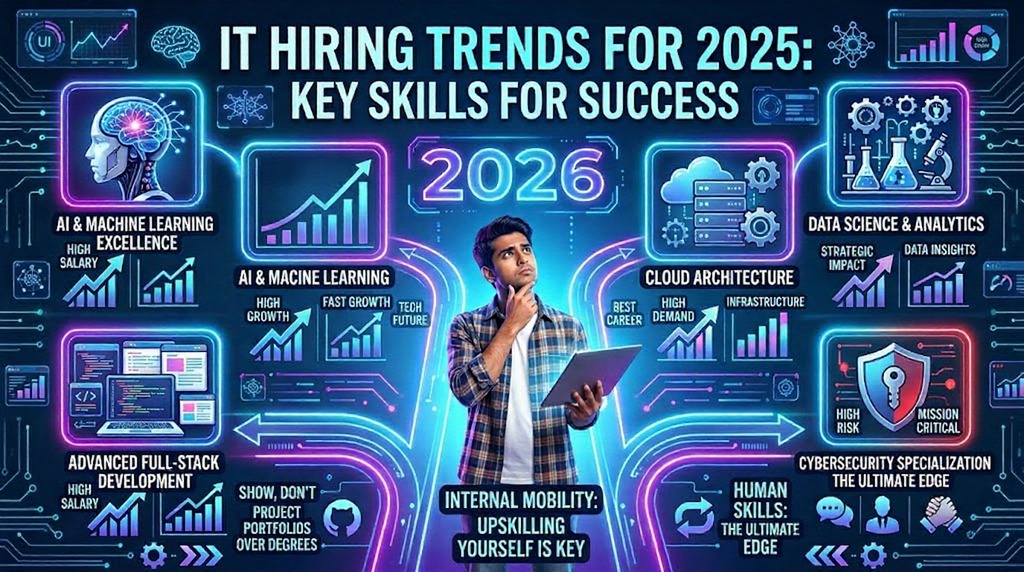
- The Trend: Tech leaders report that Artificial Intelligence, Machine Learning, and Data Engineering are among the top priorities for hiring and team expansion in 2025.
- The In-Demand Roles: AI/ML Engineers, Data Scientists, Data Engineers, and MLOps Specialists continue to see strong hiring demand across industries.
- How to Succeed: Do not just rely on AI tools or coding assistants. Focus on learning how to deploy, monitor, and scale machine learning models. Build expertise in advanced algorithms, data pipelines, and training models using real-world datasets.
2. A Shift to "Cloud-First" & Platform Engineering
While Artificial Intelligence gets most of the attention, Cloud Computing continues to remain the backbone of enterprise technology. Companies moving toward hybrid and multi-cloud environments are actively hiring professionals who can manage infrastructure, optimize performance, reduce costs, and automate deployments.
- The Trend: Modern tech infrastructure must be dynamic and scalable. Organizations are increasingly investing in Platform Engineering to create internal systems and workflows that help developers ship code securely and efficiently.
- The In-Demand Roles: Cloud Architects, DevOps Engineers, Platform Engineers, and Site Reliability Engineers (SREs).
- How to Succeed: Focus on mastering containerization, cloud infrastructure, and Infrastructure as Code (IaC) practices to stay competitive in the hiring market.
Essential Tech Stack:
| Infrastructure & Automation Tools | Cloud Platforms |
|---|---|
| Docker | AWS |
| Kubernetes | Microsoft Azure |
| Terraform | Google Cloud Platform (GCP) |
| Ansible | - |
3. Cyber-Resilience and AI Security
As businesses continue expanding their digital operations, cyber threats have become more advanced and sophisticated. Many modern attacks now use automated AI systems to target enterprise networks, making cybersecurity one of the highest priorities for organizations worldwide.
Because data breaches can lead to severe financial losses and legal consequences, security is no longer treated as an afterthought. Instead, it is integrated into the core architecture of every modern software and cloud project.
- The Trend: Rapid growth in demand for cybersecurity professionals who can manage real-time threat detection, cloud security, and AI-driven security operations.
- The In-Demand Roles: Cybersecurity Engineers, DevSecOps Specialists, Security Analysts, and Cloud Security Architects.
- How to Succeed: Build expertise in network security, penetration testing, cloud security practices, and regulatory compliance standards such as HIPAA and GDPR. Professionals who combine security knowledge with coding and cloud infrastructure skills are among the highest-paid talent in tech.
Essential Security Skills:
| Core Security Skills | Compliance & Cloud Security |
|---|---|
| Network Security | HIPAA Compliance |
| Penetration Testing | GDPR Compliance |
| Threat Detection | Cloud Security Architecture |
| DevSecOps Practices | Identity & Access Management |
4. The Rise of Global Capability Centers (GCCs)
The geographic landscape of IT hiring is rapidly changing. Global technology companies are moving beyond traditional outsourcing models and are establishing large-scale Global Capability Centers (GCCs) in major Indian tech hubs such as Bengaluru, Hyderabad, and Pune.
These centers are no longer limited to support or maintenance operations. Instead, they are leading global product development, engineering innovation, AI initiatives, and digital transformation projects.
- The Trend: GCCs are becoming strategic innovation hubs responsible for core product engineering, research, and advanced technology development.
- The Opportunity: Strong growth in campus hiring and early-career recruitment pipelines, with major IT companies expected to hire thousands of engineering graduates to support expansion plans.
- How to Succeed: Freshers and mid-level professionals should focus on building strong engineering portfolios, problem-solving skills, and product-thinking abilities. GCCs prioritize candidates who can demonstrate real-world technical expertise over generic service-based experience.
Key Areas of Hiring:
| High-Growth Domains | Preferred Candidate Skills |
|---|---|
| Product Engineering | Strong Coding Skills |
| Artificial Intelligence | Problem Solving |
| Cloud & DevOps | Product Thinking |
| Digital Transformation | Project Portfolios |
The current tech market doesn't reward passive credentials or memorized code syntax; it rewards verifiable proof of skill. Focus on building a consistent, data-backed portfolio of working applications, stay adaptable to emerging frameworks, and your career success will become inevitable.